
NEUROFEEDBACK · UAE · WHAT THE EVIDENCE SAYS
What Is Neurofeedback — and Does It Actually Work?
15 January 2025· 9 min read· Brain Science · neurofeedback UAE · neurofeedback Dubai · does neurofeedback work · EEG biofeedback Dubai
Neurofeedback has been around for over 50 years. It was first used with epilepsy patients in the 1970s when researchers noticed that training certain brainwave patterns appeared to reduce seizure frequency. Since then it has expanded significantly — used across ADHD, anxiety, depression, PTSD, sleep disorders, and increasingly, performance optimisation for high-functioning adults.
When people first encounter it, the most common question is a healthy one: does it actually work? This post gives you a straight answer — including where the evidence is strong, where it's still developing, and what to watch out for when choosing a provider in the UAE.
The Core Idea: Training the Brain Like a Muscle
Your brain produces electrical signals constantly — oscillating at different frequencies depending on what you're doing, thinking, or feeling. Neurofeedback is a form of biofeedback that targets these patterns directly.
Here's how it works in practice: sensors placed on your scalp detect your live brainwave activity. That activity is translated in real time into an audio or visual signal — often a sound, a tone, or an element in a simple game or video. When your brain produces the targeted frequency pattern (say, more calm alpha waves, less anxious high-beta), the feedback signal rewards you. When it drifts from the target, the signal pauses or dims.
You're not consciously trying to make anything happen. The brain learns through repetition, the same way it learns any skill — through feedback and reinforcement. Over sessions, it begins to self-regulate more efficiently, without you having to think about it.
Neurofeedback isn't about willpower or relaxation techniques. It's operant conditioning applied directly to brainwave patterns — the brain learns by doing, not by being told what to do.
What Does a Session Actually Look Like?
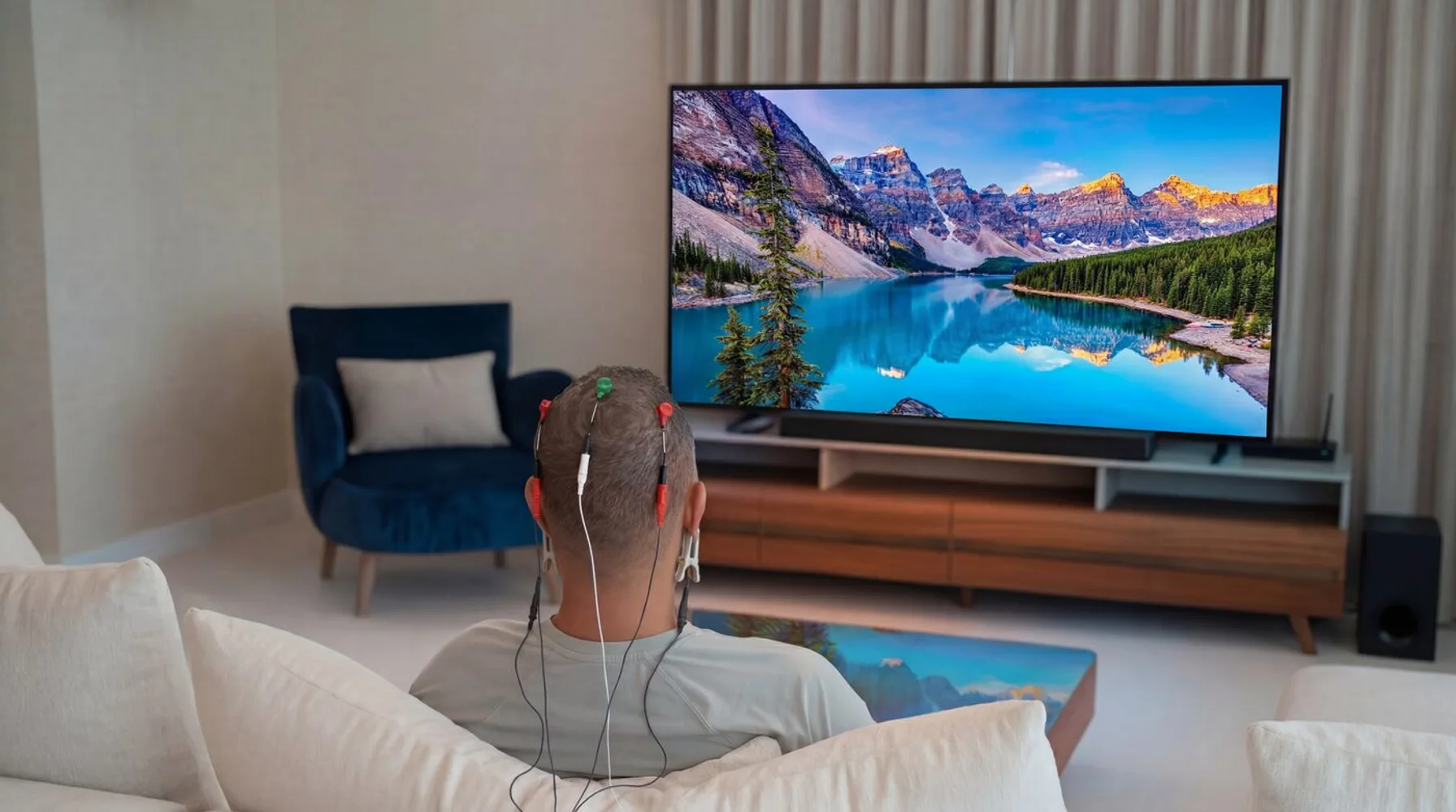
A typical neurofeedback session lasts 30 to 45 minutes. You sit in a comfortable chair with sensors attached to specific points on your scalp (guided by your brain map, if one was taken). You watch or listen to the feedback signal — often something as simple as a film that plays when your brainwaves are on target and pauses when they're not.
Most people find sessions calming. There's nothing to actively do. The work happens at a level below conscious effort. After a session, many people report feeling noticeably clearer or more settled, though this can vary, especially early in a programme.
Sessions are typically conducted two to three times per week. A standard programme runs 20 to 40 sessions depending on goals and starting point, though some people notice meaningful shifts earlier.
What Does the Evidence Actually Say?
This is the question that deserves a real answer — not marketing language. The short version: the evidence is strong in some areas, promising in others, and still developing in a few. Here's how it breaks down by condition.
| Condition | Verdict | What the research shows |
|---|---|---|
| ADHD | Strong evidence base | Decades of research. Multiple meta-analyses show improvements in attention and impulsivity comparable to medication, with effects that persist after training ends. |
| Anxiety | Strong, growing body of evidence | Alpha/theta protocols consistently show reductions in anxiety symptoms. A 2024 review found near 50% symptom reduction across multiple trials. |
| Sleep disorders | Good evidence, positive outcomes | Particularly effective for insomnia where overactive beta activity at night is a factor. Patients report improved sleep quality and reduced time to fall asleep. |
| Depression | Promising, especially with QEEG guidance | QEEG-guided protocols show significantly better outcomes than generic approaches. Studies indicate up to 60% improvement in treatment response. |
| PTSD | Solid evidence, especially for hyperarousal | Reductions in hypervigilance and improved emotional regulation with alpha training when used alongside trauma therapy. |
| Cognitive performance | Emerging, widely used in practice | Athletes, executives, and surgeons use neurofeedback for focus and stress resilience. Research is promising but less controlled than clinical studies. |
A fair summary: neurofeedback is not a fringe therapy. It has been studied for five decades, used in clinical settings worldwide, and is increasingly mainstream in neurological and psychiatric care. The evidence is strongest for ADHD and anxiety, good for sleep and depression, and promising across a wider range of applications. The best outcomes consistently come from programmes that begin with a brain map and tailor the protocol to the individual.
Neurofeedback vs. Medication vs. Talk Therapy
This comparison matters, because most people exploring neurofeedback are doing so alongside — or instead of — other approaches. Here's an honest look at how they differ.
| Factor | Neurofeedback | Medication |
|---|---|---|
| Invasiveness | Non-invasive | Systemic |
| Side effects | Minimal / rare | Can be significant |
| Lasting change | Evidence of durability | Dependent on continued use |
| Time commitment | 20–40 sessions | Daily, low effort |
| Personalisation | High (with QEEG) | Moderate |
| Best used | As primary or adjunct treatment | When rapid relief is needed |
Most practitioners would say these aren't competing approaches — they can work well together. Neurofeedback's particular advantage is that the changes it produces are trained into the brain's patterns rather than dependent on an ongoing external input. That durability is one of the main reasons people choose it.
Who Is Neurofeedback Designed For?
Neurofeedback works across a wide range of people and goals. In UAE clinics, the most common profiles tend to be:
- Adults dealing with anxiety or chronic stress. Dubai's pace is relentless — long hours, high performance expectations, frequent disruption. Many people find that standard stress management isn't enough when the brain's baseline is wired toward alertness.
- Children and adults with ADHD. Neurofeedback is one of the most studied non-pharmacological interventions for attention difficulties, with effects that persist after the programme ends.
- People struggling with sleep. When overactive brain patterns at night are the source of insomnia rather than lifestyle factors, neurofeedback can directly address the neurological driver.
- High performers seeking an edge. Athletes, executives, surgeons, and creatives use neurofeedback to sharpen focus, improve emotional regulation under pressure, and reduce performance anxiety.
- Individuals recovering from head injury or concussion. Post-concussion syndrome often involves dysregulated brainwave patterns; neurofeedback is used to support recovery and re-establish normal functioning.
What to Expect: A Realistic Timeline
Neurofeedback is not a quick fix. Anyone telling you otherwise is overselling it. Most people notice initial shifts in sleep quality, focus, or mood within the first five to ten sessions. More stable, generalised changes typically consolidate across 20 to 30 sessions. Some conditions or goals require 40 or more.
The pace varies. Stress and sleep conditions often respond relatively quickly. ADHD and trauma-related patterns tend to require more sessions. A practitioner using your brain map to guide the programme — and adjusting the protocol based on follow-up mapping — will give you the most efficient path through.
How to Choose a Neurofeedback Provider in the UAE
The quality of providers varies meaningfully. Before committing to a programme, it's worth asking a few direct questions.
- Does the clinic begin with a full QEEG brain map? Generic, one-size-fits-all neurofeedback protocols are less effective than those tailored to your specific brainwave patterns. If a clinic doesn't map before they train, ask why.
- Who is interpreting the data and designing your protocol? This should be a qualified clinician — ideally one with specific training in QEEG analysis. Software alone isn't enough.
- What equipment do they use? Look for systems with at minimum 19 EEG channels and established clinical neurofeedback platforms. Consumer-grade equipment is not the same.
- Do they track progress with follow-up mapping? A midpoint QEEG lets your practitioner verify that your brainwave patterns are actually shifting — not just relying on subjective reports.
Neurofeedback isn't magic, but it's also not pseudoscience. It's a training method with a meaningful evidence base, real clinical applications, and outcomes that — when the programme is designed well — tend to last.
FAQs
Common Questions
Frequently Asked Questions
Ready for QEEG brain mapping or neurofeedback therapy in Dubai?
Talk to MindTune